
Sacroiliac Joint RFA
If SI joint injections have given you good but short-lived relief, RFA is the logical next step. It targets the nerves supplying the joint and can keep the pain away for 1–2 years.
Your journey
Your Road to a Pain-Free Life
Test your knowledge
How Well Do You Know This Procedure?
Frequently asked questions
What is Sacroiliac Joint RFA?
Sacroiliac Joint Radiofrequency Ablation (RFA) is a procedure that uses controlled heat to disrupt the lateral branch nerves, the nerves that carry pain signals from the SI joint to your brain. Once these nerves are ablated, the pain signals are interrupted, giving you long-term relief. The procedure typically lasts 1–2 years, after which the nerves may partially regenerate and the procedure can be safely repeated.
Who is a good candidate for SI Joint RFA?
You are a candidate if you have confirmed SI joint pain, meaning a diagnostic SI joint injection gave you at least 50–75% pain relief. Patients who respond well to injections but need repeated shots every few months benefit the most from RFA. It offers the same relief for significantly longer.
How is SI Joint RFA different from an injection?
An SI joint injection reduces inflammation using a steroid. It does not change the nerve. RFA uses heat to ablate the nerve fibres carrying the pain signal. Injections typically last weeks to months; RFA typically lasts 12–24 months. They are complementary steps in the same treatment pathway, not competing alternatives.
How is Sacroiliac Joint RFA performed?
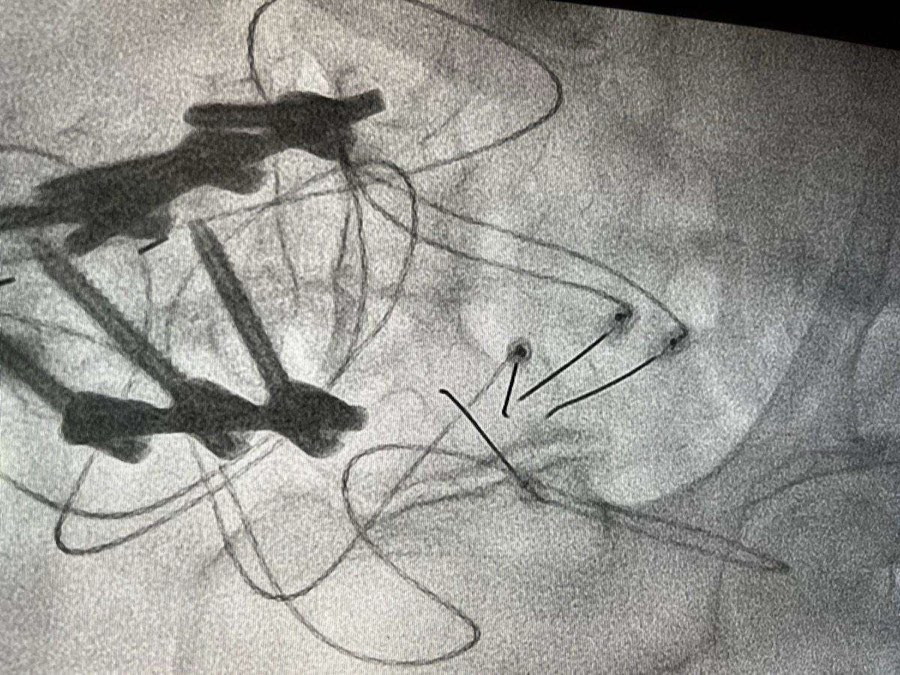
You lie face-down. Under fluoroscopy guidance, RF cannulas are placed at the S1, S2, and S3 posterior sacral foramina (openings) where the lateral branch nerves exit, and at the L4 junction. A test stimulation confirms correct positioning. Radiofrequency current then heats the probe tip to ablate the nerves. Multiple small lesions are made to cover the SI joint's nerve supply completely. The procedure takes 30–45 minutes.
When will I start feeling better after SI Joint RFA?
Unlike an injection, the relief from RFA builds gradually. Most patients notice meaningful improvement within 2–4 weeks. Full benefit is usually felt by 6–8 weeks. The procedure site may feel tender for 1–2 weeks after the ablation. This is normal and settles on its own.
How long does pain relief from Sacroiliac Joint RFA last?
Relief typically lasts 12–24 months. The lateral branch nerves are small and can regenerate over time. When pain returns, the procedure can be safely repeated, and the second time around, many patients respond just as well or even better.
What should I do if SI joint pain returns after RFA?
Contact us for a follow-up assessment. If the SI joint is still the pain source and the nerve has regenerated, a repeat RFA is the most appropriate option. Between now and your follow-up, continue any core strengthening or physiotherapy exercises. These protect the joint and extend the benefit of each procedure.
Any concern?