Home Care: Pain Management in the Comfort of Your Home
When pain or mobility make travelling to a clinic difficult, expert pain management should still be accessible. We bring assessment, medication optimisation, and support directly to you.
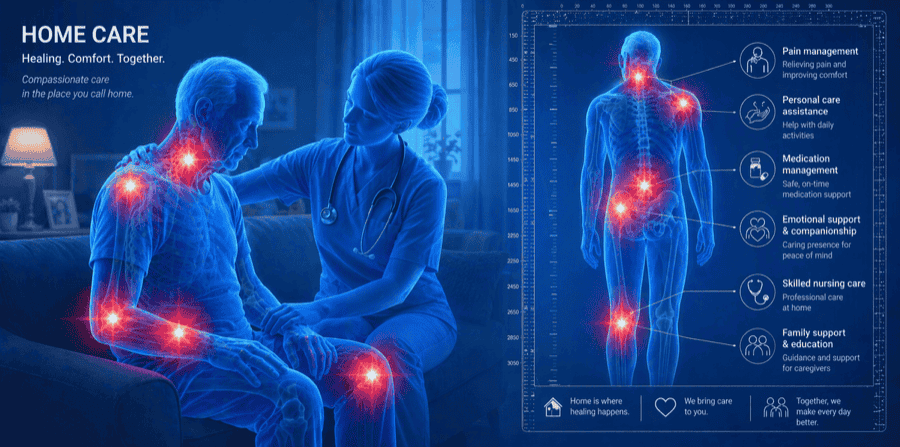
Good pain management should not be contingent on the ability to travel. For patients whose pain, illness, or mobility make clinic visits burdensome or impossible, home-based pain care brings the clinical expertise of a specialist directly into the patient's environment — where they are most comfortable and most able to engage.
What Is Home-Based Pain Care?
Home-based pain care refers to pain management services delivered in the patient's home environment rather than in a clinical setting. This includes home visits by Dr. Ashu Kumar Jain for assessment and review, teleconsultations for ongoing prescription management, caregiver training, and written pain management plans that empower the patient and their family to manage pain effectively day to day.
Home care is not a lesser form of pain management. In many cases it produces better outcomes than clinic-based care because the assessment takes place in the actual environment where the patient lives with their pain — revealing factors that would not be visible in a brief clinic appointment.
For palliative patients, home care is often not just convenient but essential. Travelling to a clinic can itself be a source of pain, anxiety, and exhaustion that is simply not justified when expert care can come to the patient instead.

When Home-Based Care Is the Right Choice
Home-based care is appropriate in the following situations:
- Advanced or Palliative Illness: Patients with advanced cancer, organ failure, or other life-limiting conditions for whom clinic travel is exhausting, painful, or distressing. Home visits avoid unnecessary suffering and preserve the patient's limited energy for what matters to them.
- Severe Spinal Pain or Mobility Limitation: Patients with severe disc herniation, spinal stenosis, compression fractures, or other conditions that make sitting, standing, and transferring extremely painful. Getting into and out of a car can be the most painful part of their day.
- Post-Procedure Recovery: Patients who have recently undergone spinal or other procedures and who are in the recovery phase where clinic travel is not practical. Teleconsultation allows safe, ongoing medication review and guidance during recovery.
- Neurological Conditions: Patients with Parkinson's disease, MND/ALS, multiple sclerosis, or stroke-related disability for whom independent travel is difficult and who benefit from pain assessment in their home environment.
- Elderly Patients with Multiple Comorbidities: Elderly patients managing complex pain alongside multiple medical conditions, for whom frequent clinic visits represent a significant burden and risk.
The Home Visit Assessment
A home visit by Dr. Ashu Kumar Jain is a comprehensive clinical encounter. It includes:
- Full pain history and functional assessment in the patient's actual environment
- Review of the patient's current medication regimen with access to all their dispensed medications — reducing the risk of errors, duplications, and omissions that are common in clinic settings
- Observation of how the patient moves, transfers, sleeps, and manages pain at home — providing clinical information unavailable in a clinic
- Discussion with family members and caregivers who are present and can provide collateral history about the patient's pain between appointments
- A written, practical pain management plan for the patient and family to follow
- Identification of any immediate safety concerns at home related to medications, mobility, or fall risk

Teleconsultation for Ongoing Pain Management
Between home visits, teleconsultation allows patients to receive prescription review, dosage adjustment, and clinical advice without needing to leave home. Teleconsultation is particularly valuable for monitoring the response to new medication changes, managing opioid side effects, reviewing pain diaries, and addressing questions from family caregivers.
We use secure video consultation platforms so that Dr. Ashu Kumar Jain can conduct a visual assessment during each call. Patients are asked to prepare a brief pain diary before each teleconsultation so that time is used efficiently and no important changes are missed.
Caregiver Training
In many home pain management situations, the family caregiver is the most important member of the clinical team. They observe the patient around the clock, administer medications, and are first to notice when pain is escalating. We invest significantly in caregiver education:
- How to assess pain in a patient who cannot communicate it clearly (using behavioural cues)
- Safe and correct administration of opioid medications including breakthrough doses
- Recognising and responding to opioid side effects
- When and how to contact the clinic or emergency services
- Maintaining a pain and medication diary that informs each clinical review
- Managing their own wellbeing as a caregiver — caregiver burnout is common and directly affects patient care
Check If You Need This Service
What we offer?
Our home-based pain management services
We bring specialist pain expertise to where the patient is — at home, where they are most comfortable and where care is most effective.
-
 Home Visit Consultation — full clinical pain assessment by Dr. Ashu Kumar Jain in the patient's home environment
-
Teleconsultation — secure video appointment for prescription review, medication titration, and ongoing pain management guidance
-
Written Pain Management Plans — clear, practical plans for the patient, family, and any nursing or home care team involved
-
Caregiver Training — education in pain assessment, medication administration, and recognising when to escalate
-
24-Hour Contact for Pain Crises — a dedicated contact route for urgent pain management questions outside of scheduled appointments
-
Coordination with Home Nursing and Specialist Teams — we communicate directly with oncologists, GPs, and home nursing services so care is cohesive

Frequently asked questions
Who is home care pain management suitable for?
Home care is suitable for patients whose pain, mobility, or medical condition makes clinic attendance difficult or distressing. This includes patients with advanced cancer or palliative illness, severe spinal conditions, neurological disability, post-operative pain, and elderly patients with complex comorbidities. It is also appropriate for patients who live at a significant distance from the clinic and for whom travel represents a major undertaking.
What happens during a home visit?
The home visit includes a full pain assessment, review of current medications, physical examination relevant to the pain condition, a discussion of treatment options and goals, and the creation of a written pain management plan. Family members or caregivers who are present are actively included in the consultation. The visit typically takes 45 to 60 minutes.
Can prescriptions be issued via teleconsultation?
Yes. For established patients — those who have had at least one in-person consultation — prescription review and renewal can be conducted via teleconsultation. Controlled medications such as opioids may require specific documentation processes in accordance with applicable pharmacy regulations, which we will guide you through. New patients require at least one initial in-person or home visit before moving to teleconsultation-only care.
Can procedures be performed at home?
Simple procedures such as subcutaneous injections and wound pain management can sometimes be provided at home where appropriate. Most interventional procedures — nerve blocks, epidural injections, pulsed RFA — require the imaging guidance, sterile environment, and monitoring facilities of a clinical procedure suite for safety. In these cases, we help arrange the most convenient location and coordinate transport support where possible.
How do I set up a home visit or teleconsultation?
Contact us by phone, WhatsApp, or email using the details below. Tell us the patient's location, their primary pain condition, and why a home visit or teleconsultation would be preferable to a clinic appointment. We will confirm availability, geographical coverage, and any preparation needed for the appointment as quickly as possible.
What areas do you cover for home visits?
We primarily cover Gurgaon (Gurugram) and the surrounding NCR areas. For patients outside this range, teleconsultation is often an appropriate alternative for initial assessment and ongoing management. Please contact us to discuss we will do our best to accommodate genuine need.
Any concern?